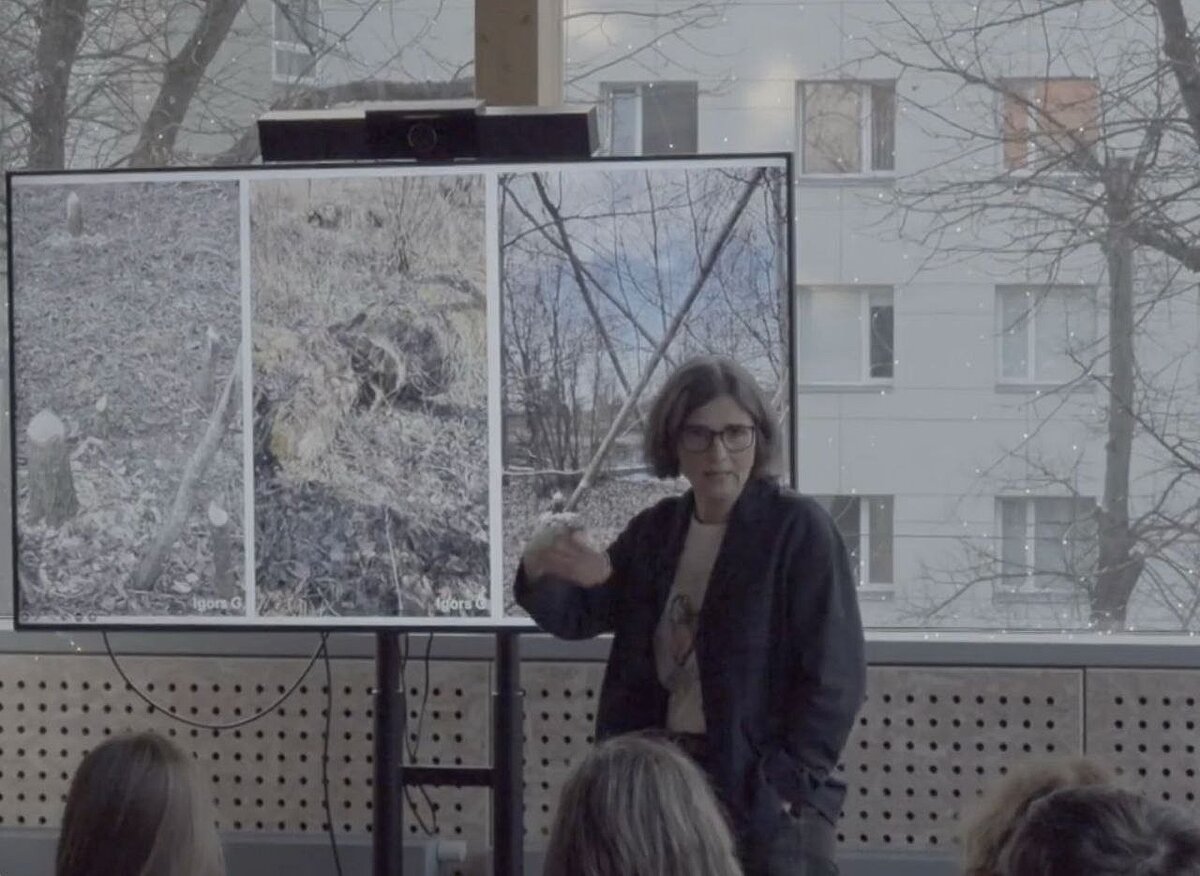
Anita Zariņa is giving a lecture or presentation to an audience. She is standing beside a large display showing several photographs of forested landscapes and natural environments while gesturing as she explains the material. Audience members are visible in the foreground, while large windows in the background overlook trees and a multi-storey building.

On 26 March 2026, Anita Zariņa gave a lecture titled Beavers and the “Messy” Ecologies of the Anthropocene as part of the Latvian Academy of Culture lecture series The Little Academy of Posthumanism. Using the beaver as a case study, the lecture explored human–wildlife relations in the Anthropocene.

The lecture drew on insights from the project’s research, with particular attention to how the beaver’s biohydrological agency transforms landscapes and challenges conventional understandings of water as controllable infrastructure. Beaver dams and wetlands were analysed not only as sources of conflict, but also as spaces of multispecies coexistence and as examples of alternative water ecologies.

The lecture also addressed the tension between the logic of drainage and control, which has long shaped water management in Latvia, and emerging ecological approaches that emphasise uncertainty, interdependence, and coexistence with the more-than-human world.

Share